Monday, February 18, 2013

Rainbow Sink

Thanks for visiting my Blog!  Please feel free to share with friends, family and Facebook. Click on any image for a larger version and ability to scroll through all photos. Then click outside the photo to return to the story.  Enjoy! 

No posts since Christmas! That's not because I don't have photos or stories... more like I have had too many recent adventures and haven't had time to process and write.  So here's a quickie for February.

Have you ever flown into Tallahassee (TLH) and looked down to see a bunch of small ponds in the forest and wondered about them?  I sure have. One of my photo pals in Wakulla County, Bob Thompsonsuggested we go explore that forest.  Bob had scouted the site via Google Earth and also knew of a road that accessed a powerline road that would get us in.

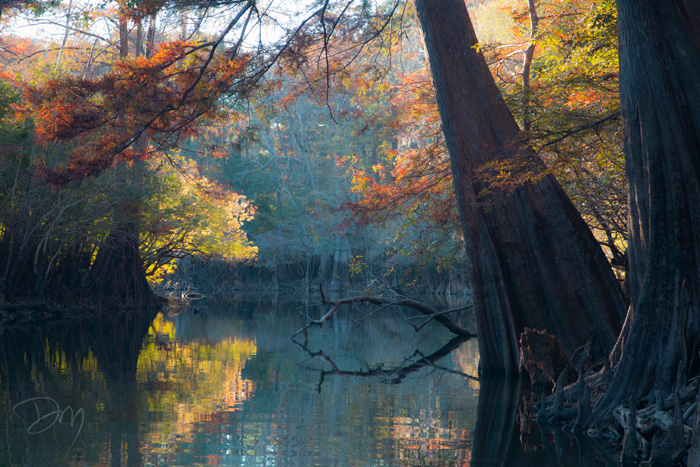
We entered a beautiful piece of the Apalachicola National Forest of pines, big live oaks, grasses, and wetlands of cypress and surprises. I often find that cypress trees hold their beauty long after they've died -- in the first instance below, as a leader into a long-shadowed sunrise.  And in the 2nd, Bob noticed the heart (see it?) and I noticed the thinness of the shell, with each buttress hollowed, like the shed exoskeleton of a "reborn"arthropod.  Where's that cypressoul growing now?


Big ol' oaks stood majestically adjacent to domes of cypress, their ground almost imperceptibly higher.  The ponds at the heart of the domes, though low, held water, lending to the life and health of this delicate ecosystem.

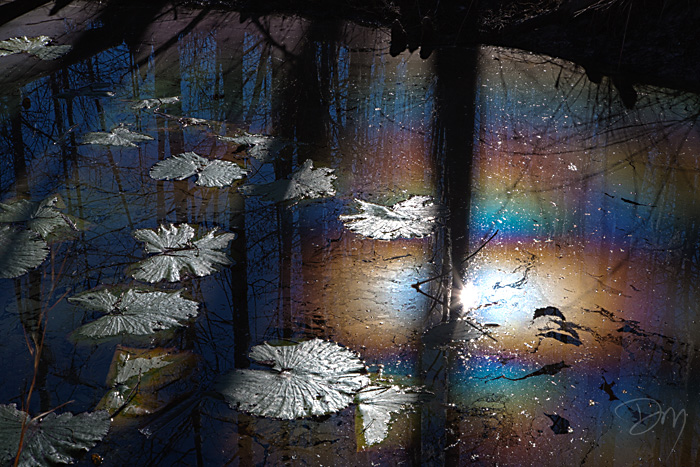
We came to two small sinkholes - unlike the ponds in that they had steep banks and deeper bottoms, perhaps even reaching down and communing with the aquifer that flowed river-like beneath us.  Here are photos from the 2nd one, dubbed Rainbow Sink for obvious reasons.  Shot across the sunbeams, this intimate sink looked sweet but ordinary.  The magic happened when we walked "down-sun" and looked back.  The light passed down through a thin layer of pollen, bounced off the surface, and then refracted through the pollen layer as if through a prism, breaking into rainbow colors as it came up to our eyes and camera lenses.  As if that wasn't enough, the lilypads turned to sharp-edged silver reliefs and the mirror-smooth water reflected the sky and surrounding forest, adding mind-bending dimension.  Wow!

So, please enjoy Rainbow Sink with me as I moved closer and closer in with my lens... (Yes, of course, I did almost fall in.)


Tuesday, December 25, 2012

Holmes Creek


Thanks for visiting my Blog!  Please feel free to share with friends, family and Facebook. Click on any image for a larger version and ability to scroll through all photos. Then click outside the photo to return to the story.  Enjoy! 

Floating through the early morning mist, it is easy to imagine how a few renegade Ivory-billed Woodpeckers could defy detection in the vast and mysterious swamps and tributaries along the Choctawhatchee River. My heart opens in the magic and awe of sunbeams slashing across the frosty polar smoke backlighting big cypress trees and flashing fall colors in hazy pastels.


Rather than the now-mythical woodpeckers, we are more simply in search of Florida’s hidden Fountains of Youth, intimate crystal blue springs too remote for most eyes. Having launched in pre-dawn darkness on Holmes Creek, we are picking our way downstream watching for side creeks, especially spring-clear tributaries.

Having turned up a promising waterway in growing light, John and I soon come to a very wide shallow section, confirmation that we are entering Mill Lake, and on the path to two named and countless smaller unnamed springs. The water is so low that we almost immediately grind to a halt on the thick mud lake-bottom and wonder if we must give up.  Twenty feet to our left, a slightly different color to the water suggests an extra inch or two --  enough to float us?  And how do we get there? The pole plunges down into bottomless mud without giving us any push. No nearby shore, no way to walk. We’re stuck.

With a paddle and shifting our weight around the boat, we make it to the slightly deeper water and freedom. We wend our way through the subtle channel, finally reaching deeper water at the far end of the lake and continuation of the creek.  Poling, paddling, and motoring upstream again, one last bend reveals a beautiful headspring called Washington Blue.  Still early and misty, we make a photo and vow to return when the sun is higher in the sky. 

We had passed another fork on our way to Blue. Where might that lead? This tiny clear creek is barely wider than the jonboat.  Surprisingly, we travel a long way upstream until becoming totally blocked by a large deadfall.  The sun is bright and air warmer -- John is overtaken by the need for a nap. Cameras in hand, I wade further upstream coming upon a lovely cypress showing off fall color.  Here it is twice – first from the viewpoint of a deer come to take a drink, and then as viewed by the the bass lurking in the big tree’s shadow.


Hiking another half mile along the stream, we reach a 2nd large headspring.  Friend, George Willson, who knows these parts as well as anyone, later identified this from the photos as Potter Spring (and the other as Washington Blue – we had them mixed up.)

An even smaller brown-water creek entices us to explore further upstream. Luckily so. We come to a gorgeous bathtub-sized spring beneath a huge tupelo tree, multiple seep springs flowing out of the bank, and bizarrely-shaped cypress knees and rooty-based trees. By the time we get back to the boat, the sun is low again.  So much for re-shooting Washington Blue. 


Next day, we are exploring the area around Millers Ferry Road.  Abstract watercolors lay at the foot of fall-colored trees in the still water of an enticing side creek. Shallows soon force us to abandon the boat.  On foot, we follow the flow through swamp and tangle. Massive cypress and bizarre stilted trees rising out of old stumps provide the “breadcrumb” landmarks we’ll need to get back.


After lunch and a hammock nap, we find a lovely spring right on Holmes Creek. Not knowing its official name, we dub it Jagged Ledge for its sawtooth rock shelf. The day is glorious.


Our final morning. We launch our canoe and kayak upstream from Cypress Spring. Another group of paddlers has just shoved off.  Holmes Creek sweeps us into its currents and pretty soon we are veering off right into the large clear spring run. Wow. What a place.  I’ll let the photos speak to its beauty. 


Homeward bound, we are fortified and fulfilled by our long drinks from a delicious sampling of Holmes Creek’s Fountains of Youth.

Wednesday, November 28, 2012

A Shoot for the Florida Fish and Wildlife Conservation Commission

Thanks for visiting my Blog!  Please feel free to share with friends, family and Facebook. Click on any image for a larger version and ability to scroll through all photos. Then click outside the photo to return to the story.  Enjoy!  

Babcock-Webb WMA

For nearly a decade now, I have been a staff photographer for the Florida Fish and Wildlife Conservation Commission, aka FWC. In the Public Access and Wildlife Viewing Office  we promote a wide range of recreational uses of our vast FWC-managed public lands throughout Florida. We want to get Floridians and visitors off their duffs and outdoors: hiking, wildlife viewing, paddling, fishing, enjoying photography, picnicking, studying nature, bicycling, horseback riding, camping, and hunting. Our Wildlife Management Areas and Wildlife and Environmental Areas are places that welcome visitors, but lots of people don't know about them.  But the animals do. These lands are managed for and used by wild turkeys, gopher tortoises, deer, and thousands of other animal species, not to mention the natural Florida flora.  So you may want to join the other critters out there at an FWC site near you, once you see what you're missing.  Find out about properties near you here: http://myfwc.com/

A month ago I made a loop around the state photographing a selection of areas where brochures, signs,  educational kiosks, and/or websites need updating.  What a great assignment, eh?  Here's a sampling of some of the sites I visited, as well as a few from other FWC shoots.

Let's start with Chassahowitzka WMA:


Then there is the jewel of Babcock-Webb WMA in Charlotte County.


Chinsegut Conservation Center and Big Pine Tract are not far from Brooksville.


Jones-Hungryland WEA is near Jupiter:


Guana River WMA is a gorgeous tract between St. Augustine and Jacksonville.


And back near my home, the Aucilla WMA.  This is only a tiny taste since I've written about it in other blogs, but I've included a couple shots from a family program at Goose Pasture.


So that's a sample of beautiful places that belong to all Floridians and managed by FWC.  So let's get off our duffs and get out into nature.   Ahhh... my next outing is this evening... a full moon rising at sunset.